

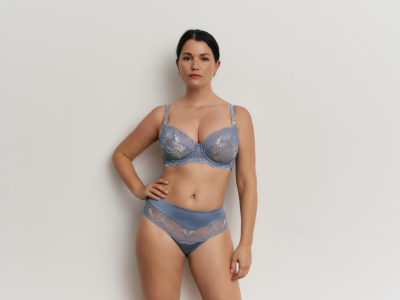
Finding a beautiful bra is important, but making sure it fits your body correctly matters even more. The right size offers support, moves with you, and lets you wear the garment for hours without digging in, shifting out of place, or leaving marks it doesn’t need to.
That said, your body changes, and the size you wore a few years ago may no longer be the right one. That’s why knowing how to take your measurements and recognise the signs of a poor fit is so important.
In this guide we explain how to find your bra size, what the number and letter actually mean, and what details to check when you try on a new style.
Why does wearing the correct bra size matter?
A bra should adapt to you, not the other way around. When the size and pattern are right, the bust is held in place, the band stays stable and the straps don’t have to carry all the weight.
On the other hand, the wrong size can cause:
- Straps that dig in or keep slipping down.
- A band that’s too tight or that rides up your back.
- Cups that leave empty gaps.
- Bust spilling out over the top or the sides.
- Underwires that don’t sit properly around the bust.
- A feeling of pressure or discomfort by the end of the day.
Beyond getting the size right, it’s important to choose a design that suits the shape of your bust and the kind of support you’re looking for. In Promise’s bra collection you’ll find different patterns, cups and finishes for every need.
What do the number and letter on a bra mean?
A bra size is made up of a number and a letter, such as 90B, 95C or 100D. Each part refers to a different measurement:
-
The number indicates the band size, meaning the measurement taken just below the bust.
-
The letter indicates the cup size, based on the difference between the bust measurement and the measurement taken underneath the bust.
This means two women with a similar band size may need different cup sizes. Likewise, the same cup letter doesn’t have exactly the same volume across every band size.
That’s why, to really understand how to find your correct bra size, it isn’t enough to look at the number alone or compare the garment with another bra you already own.
How to find your bra size, step by step
To take your measurements you’ll need a flexible tape measure. It’s best to do this without a bra, or wearing a thin, unpadded one that doesn’t alter the natural shape of your bust.
Stand in a relaxed position, keep your posture natural, and make sure the tape stays straight and parallel to the floor.
1. Measure your band size
Wrap the tape measure around your torso, just below your bust. It should feel snug, but without compressing your skin or making it hard to breathe.
This measurement is used to determine the band size. Check that the tape doesn’t tilt up or down at the back, as this could throw off the result.
2. Measure your bust size
Next, wrap the tape measure around your bust, passing over the fullest part. Don’t pull it too tight, and don’t leave it too loose either.
If possible, take the measurement in front of a mirror to check that the tape stays level all the way around.
3. Compare your measurements with a size guide
Once you have both measurements, compare them with the manufacturer’s size guide. Your band measurement will help you identify the number, while the difference between the two measurements will point you towards the cup size.
Size equivalents can vary slightly between brands, countries and patterns. For this reason, a size chart should be used as a starting point and always confirmed with a proper fitting.
How to check if a bra fits you well
Measurements are a very useful reference, but a body can’t be reduced to two numbers. The shape of your bust, how it’s distributed, and each bra’s pattern also affect the result.
When you try on a style, check the following points.
The band should sit straight
The band provides much of the support. It should stay horizontal, firm and at the same height at the front and back.
If it rides up at the back, the band is probably too big. If it feels overly tight, makes breathing difficult, or leaves deep marks, you may need a bigger band size.
When you wear a new bra, it’s best to fasten it on the loosest hook. That way you can move to the inner hooks as the fabric stretches with wear.
The cups should hold your entire bust
Your bust should sit completely inside the cups, without spilling out at the top, bottom or sides.
If wrinkles form or there’s empty space, the cup may be too big, or the pattern may not suit the shape of your bust. If the fabric cuts into your bust or it spills out, you probably need a bigger cup size.
The underwires should sit around your bust
On underwired bras, the wire should rest around the bust without sitting on top of the breast tissue. It should also stay in place when you raise your arms or move around.
If the underwire digs in, shifts around, or doesn’t fully hold your bust, it’s worth trying a different cup, band size or pattern.
The straps shouldn’t be doing all the work
The straps should stay firm without digging into your shoulders. If you have to pull them very tight to lift your bust, the band may be too big and isn’t doing its job properly.
It’s also important to adjust them regularly, as they can loosen with wear and washing.
The centre gore should stay in place
On many underwired bras, the centre piece between the cups should sit close to the body. If it lifts away or shifts, it can be a sign that the cup is too small or that the pattern doesn’t suit the shape of your bust.
Does bra size change depending on the style?
Even if the size on the label is the same, the fit and feel can vary depending on the design. Cup shape, padding, fabric stretch and the garment’s structure all affect how it adapts to your body.
For example, push-up bras are designed to lift the bust and create a more defined cleavage. When trying them on, check that your bust stays inside the cup and that the lifting effect doesn’t create pressure or spillage.
Padded bras add shape and more even coverage. With this type of style, it’s especially important to avoid gaps between your bust and the cup.
A triangle bra, on the other hand, can offer a lighter feel and a more natural shape. Because it has a different structure, it may suit some bust types better than others.
This doesn’t necessarily mean you need a different size for every style, but rather that you should judge the overall fit instead of relying on the label alone.
Common mistakes when choosing your bra size
One of the most common mistakes is sticking with the same size for years without taking your measurements again. The body can change for many reasons, even when the change isn’t obvious at first glance.
It’s also common to:
- Choose a bigger band to stop the bra from feeling tight.
- Compensate for a band that’s too loose by pulling the straps in a lot.
- Wear a cup that’s too small because the band feels right.
- Assume that every style in the same size will fit the same way.
- Overlook the fact that a pattern may not suit the specific shape of your bust.
- Try on a bra without properly positioning your bust inside the cups.
To check the fit, lean forward slightly and gently sweep your entire bust into each cup, including the side area. Then stand up straight again and check the result.
When should you measure your bra size again?
There’s no single rule that applies to everyone, but it’s worth checking your size whenever you notice changes in fit, or after a significant change in your body.
It may be a good time to measure yourself again if:
- You’ve gained or lost weight.
- You’ve been through pregnancy or breastfeeding.
- You’ve experienced hormonal changes.
- The band on your bras keeps riding up.The straps keep digging in or slipping down.
- Your bust no longer feels as held in place as before.
- Your usual styles have stopped feeling comfortable.
You should also factor in wear and tear on the garment itself. With use and washing, elastic fabrics can lose their firmness, meaning a bra that used to fit perfectly may no longer offer the same support.
Finding the bra that suits you best
Knowing how to measure your band and bust is the first step, but finding the right bra also means paying attention to how it behaves as you move.
Walk, raise your arms, sit down, and check that the band doesn’t shift, that the cups keep holding your bust in place, and that you can breathe normally. A good bra should stay with you throughout the day without you having to keep adjusting it.
At Promise you’ll find bras with different levels of support, structures and finishes, so you can choose the style that best suits your body, your taste and every occasion.
Frequently asked questions about how to find your bra size
How often should I check my bra size?
It’s best to do it whenever there’s a significant change in your body, or if you notice your usual bras aren’t as comfortable as they used to be.
Can my bra size change over the years?
Yes. Factors such as age, hormonal changes, pregnancy or weight fluctuations can change the volume and shape of your bust.
Is it normal to wear different sizes depending on the brand?
Yes. Although sizing follows similar standards, each manufacturer may apply slight variations in their patterns.
What does it mean if the bra band rides up at the back?
Generally, it’s a sign that the band is too big and isn’t providing the right level of support.